Fire Mitigation Longmont CO, Defensible Space and Fuel Reduction
The 2021 Marshall Fire burned more than 1,000 structures in Superior and Louisville, communities fewer than 15 miles from Longmont. Defensible space is no longer a theoretical concept for Boulder County homeowners. Our fire mitigation crew creates and maintains defensible space per Colorado’s NFPA 1144 guidelines for properties across Longmont, the Boulder County foothills, and the urban-wildland interface throughout the Northern Front Range. Colorado Department of Agriculture licensed. ISA certified arborist on staff.
What Is Fire Mitigation in Longmont CO?
Fire mitigation for trees and vegetation is the systematic reduction of fuel load on your property to slow fire spread, protect structures, and create defensible space for firefighters working to save your home. It follows specific zone requirements from the National Fire Protection Association (NFPA 1144) and Colorado’s wildfire mitigation guidelines: Zone 1 (0 to 30 feet from structure), Zone 2 (30 to 100 feet), and Zone 3 (100 to 300 feet for larger properties). Work in each zone has specific fuel reduction targets, tree spacing requirements, and vegetation height limits.
Fire mitigation is not the same as clear cutting your property. A well executed fire mitigation plan preserves valuable trees that are properly spaced, removes the high risk fuel sources. Beetle killed standing dead trees, ladder fuels that allow fire to climb from ground level into the canopy, and dense vegetation clusters. It creates a landscaping approach that slows fire spread without eliminating the landscape character of your property.
Who Is This Service For in Longmont CO?
Fire mitigation and defensible space services are most often needed by Longmont and Boulder County homeowners whose properties sit in or adjacent to the wildland urban interface, property owners who received a notice from Boulder County or Longmont Fire Rescue recommending defensible space improvements, homeowners in the foothill communities of Lyons, Jamestown, Ward, Gold Hill, and surrounding areas within our service range who need fuel reduction work, anyone who took the 2021 Marshall Fire as the motivation to finally take wildfire mitigation seriously on their own property even if it wasn’t directly in the fire path, HOAs managing common areas in Boulder County communities with significant tree and vegetation density that creates cumulative fire risk, and real estate buyers and sellers dealing with fire hardening requirements in the Boulder County transaction market.
The Marshall Fire Context, Why Boulder County Fire Mitigation Matters
The December 2021 Marshall Fire was the most destructive wildfire in Colorado history by structure loss. It burned in conditions 100+ mph Chinook winds, months of drought, and dry grass from an early snow-free fall that can and do recur throughout Boulder County every year. The fire moved faster than most residents could evacuate, and it burned through suburban and even quasi-urban settings that most homeowners had assumed were too developed to be at serious risk.
Defensible space doesn’t make your property fireproof, nothing does in those conditions. What it does is slow fire spread, reduce ember ignition risk on your home’s exterior, and give firefighters a defensible perimeter if they’re in a position to protect structures. For properties in Longmont’s western neighborhoods approaching the foothills, and throughout the Boulder County interface communities, it’s one of the most meaningful property improvements you can make.
How Our Fire Mitigation Service Works in Longmont CO

Fire Risk Assessment of Your Property
Our ISA certified arborist walks your property and identifies the specific fuel reduction work needed in each zone. We review any existing assessments from Longmont Fire Rescue or Boulder County and align our plan with those recommendations. Trees that are high risk fuel sources are identified separately from trees that are valuable defensible space assets.

Written Defensible Space Plan and Estimate
We provide a written plan describing the specific work to be done in each zone. What trees come out, what trees are pruned, what vegetation is treated, and the target spacing and fuel load outcomes. Free written estimate included with the plan. No work begins without your approval.

Licensed Tree and Vegetation Work
Our Colorado Department of Agriculture licensed crew executes the plan. Tree removal, selective thinning, canopy lifting (raising lower limbs to reduce ladder fuels), and vegetation management are all performed by our licensed team. All removed material is chipped and hauled away.

Documentation for Insurance and Compliance
We provide photos and documentation of completed work for your records, your homeowner’s insurance provider, and any county or municipal reporting requirements. Ongoing maintenance programs available for Boulder County properties where annual return visits maintain the defensible space as vegetation regrows.
Colorado Fire Mitigation Specifics for Longmont Properties
Boulder County has identified high and very high fire hazard severity zones throughout the county. Check your property’s designation at the Boulder County website before planning mitigation work to understand which standards apply to your specific address.
Beetle killed ponderosa pines are among the highest risk fuel sources on Boulder County interface properties. Standing dead trees with loose bark and dry crown are significantly more combustible than living trees and should be prioritized for removal.
Ladder fuels. The low shrubs, tall grasses, and lower limbs on trees that allow fire to climb from ground level into the canopy. Are as important as horizontal tree spacing. Vertical fuel management is a specific part of our mitigation work.
Colorado’s Zone 1 (0 to 30 feet from structure) requires the most intensive fuel management. No combustible mulch, irrigated low growing plants only, trees pruned to 6 feet from the ground, no continuous vegetation connecting to the structure.
Zone 2 (30 to 100 feet) requires appropriate tree spacing. Typically 10 feet between crown edges for trees on flat ground, increasing on slopes. And significant reduction of shrub cover and continuous vegetation.
Longmont Fire Rescue offers free defensible space assessments for properties in fire risk areas. Our crew integrates with their recommendations when an assessment has been completed.
Fire Mitigation Pricing in Longmont CO
Fire mitigation pricing in Longmont depends on property size, vegetation density, terrain, access, and the amount of fuel reduction required in each mitigation zone. Here are typical ranges for the Longmont market:
Get My Free Fire Mitigation AssessmentZone 1 fuel reduction (0 to 30 ft from structure)
$500 to $2,500
Zone 2 fuel reduction (30 to 100 ft)
$1,200 to $5,000
Full property mitigation (all applicable zones)
$2,000 to $12,000+
Beetle kill tree removal (per tree)
$350 to $1,400 depending on size
Annual maintenance program
Custom quote based on property
Call for Assessment
(720) 999-9294
Fire Mitigation Frequently Asked Questions , Longmont CO
Who assesses the fire risk level of my property in Longmont?
Boulder County's Building and Planning department maintains fire hazard severity zone maps for the county. Longmont Fire Rescue also offers free defensible space assessments for properties in high-risk areas. Our ISA certified arborist assesses your specific property's fuel load and recommends mitigation work, and we align our recommendations with any existing Longmont Fire Rescue or Boulder County assessment when one has been completed.
Can I get insurance credit for fire mitigation work in Longmont?
Some Boulder County homeowner's insurance carriers offer premium reductions or coverage extensions for documented defensible space work, particularly following the post-Marshall Fire insurance market changes in Colorado. We provide documentation of completed work for your insurance provider. Check with your specific carrier about their defensible space credit policies, requirements vary significantly between insurers.
The 2021 Marshall Fire, What It Changed for Longmont Area Homeowners
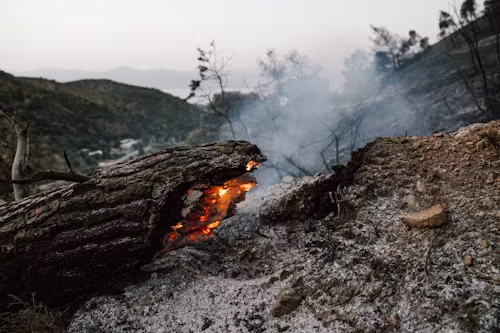
Before December 2021, most Boulder County suburban homeowners thought wildfire was a problem for mountain properties, not suburban neighborhoods. The Marshall Fire proved otherwise. It burned at 100+ mph Chinook wind speeds through grass-covered suburban land and took out over 1,000 structures in a matter of hours. The conditions that created the Marshall Fire months of drought, an early snowless fall, and severe Chinook winds recur throughout Boulder County every few years.
Longmont's western neighborhoods, the properties along the Diagonal Highway approaching Boulder, and communities throughout the urban-wildland interface are not categorically different from what burned in 2021. Defensible space is not about preparing for the unlikely. It's about preparing for a predictable event on an uncertain timeline.
Maintaining Your Defensible Space Over Time in Longmont
Defensible space is not a one time project. Vegetation regrows, new growth fills the gaps you created, and beetle killed trees continue to accumulate on Front Range properties each year. Boulder County's fire mitigation standards require ongoing maintenance not just initial creation of defensible space zones. Our annual fire mitigation maintenance programs return to your Longmont or Boulder County property on a scheduled basis to maintain the Zone 1 and Zone 2 clearances you established in the initial mitigation work. Without ongoing maintenance, defensible space degrades over 3 to 5 years to the point where it no longer provides meaningful protection.
Fire Mitigation vs Standard Tree Removal in Longmont
Fire mitigation tree work is distinct from standard tree removal in several important ways. The objective is fuel load reduction and structural fire resistance, not simply removing unwanted trees. This means selective work keeping some trees while removing others based on species, spacing, condition, and location relative to your structure. An ISA certified arborist guides fire mitigation work with specific knowledge of which tree species present higher or lower fire risk (beetle killed pines at the extreme high end; irrigated deciduous trees at the lower end), how to create effective canopy separation that prevents fire from jumping between tree crowns, and what documentation Boulder County fire mitigation assessors expect to see when they review completed mitigation work.
"Had two dead ponderosa pines removed from our West Longmont property. Crew was professional, rigging was excellent, they dropped both trees exactly where they said they would. Yard was spotless when they left. ISA certified team made the whole process easy and safe."
Verified Customer, West Longmont CO 80503"Emergency tree removal after a spring blizzard split our massive cottonwood near Main Street. Called at 8am and they had a crew there by noon. The tree was blocking our garage door. Efficient, safe, and fair price under pressure."
Verified Customer, Old Town Longmont CO 80501"Large honey locust too close to our power line along Highway 287. They coordinated with the utility company, used proper directional rigging, and took the whole thing down without a single problem. Professional job from start to finish."
Verified Customer, East Longmont CO 80502"Had two dead ponderosa pines removed from our West Longmont property. Crew was professional, rigging was excellent, they dropped both trees exactly where they said they would. Yard was spotless when they left. ISA certified team made the whole process easy and safe."
Verified Customer, West Longmont CO 80503"Large honey locust too close to our power line along Highway 287. They coordinated with the utility company, used proper directional rigging, and took the whole thing down without a single problem. Professional job from start to finish."
Verified Customer, East Longmont CO 80502"Emergency tree removal after a spring blizzard split our massive cottonwood near Main Street. Called at 8am and they had a crew there by noon. The tree was blocking our garage door. Efficient, safe, and fair price under pressure."
Verified Customer, Old Town Longmont CO 80501"Had two dead ponderosa pines removed from our West Longmont property. Crew was professional, rigging was excellent, they dropped both trees exactly where they said they would. Yard was spotless when they left. ISA certified team made the whole process easy and safe."
Verified Customer, West Longmont CO 80503"Emergency tree removal after a spring blizzard split our massive cottonwood near Main Street. Called at 8am and they had a crew there by noon. The tree was blocking our garage door. Efficient, safe, and fair price under pressure."
Verified Customer, Old Town Longmont CO 80501"Large honey locust too close to our power line along Highway 287. They coordinated with the utility company, used proper directional rigging, and took the whole thing down without a single problem. Professional job from start to finish."
Verified Customer, East Longmont CO 80502"Had two dead ponderosa pines removed from our West Longmont property. Crew was professional, rigging was excellent, they dropped both trees exactly where they said they would. Yard was spotless when they left. ISA certified team made the whole process easy and safe."
Verified Customer, West Longmont CO 80503"Large honey locust too close to our power line along Highway 287. They coordinated with the utility company, used proper directional rigging, and took the whole thing down without a single problem. Professional job from start to finish."
Verified Customer, East Longmont CO 80502"Emergency tree removal after a spring blizzard split our massive cottonwood near Main Street. Called at 8am and they had a crew there by noon. The tree was blocking our garage door. Efficient, safe, and fair price under pressure."
Verified Customer, Old Town Longmont CO 80501Frequently Asked Questions
What is defensible space and how much do I need in Longmont?
Defensible space is the buffer of managed vegetation and fuel reduction between your home and the surrounding natural landscape. Colorado follows NFPA 1144 guidelines: Zone 1 (0 to 30 feet, most intensive management), Zone 2 (30 to 100 feet, moderate fuel reduction). Some properties in higher risk areas require Zone 3 management to 300 feet. Our ISA arborist assesses your specific property and tells you exactly what your situation requires.
Will removing trees reduce my property value in Longmont?
Not when done correctly. Strategic fuel reduction that improves fire resilience while maintaining appropriate canopy cover and landscape aesthetics has no negative effect on property value in Boulder County and in fire risk areas, documented mitigation work can reduce insurance premiums and increase appeal to informed buyers. Poorly planned clearance that removes all trees indiscriminately is different which is why ISA certified assessment and selective removal is critical.
Does my homeowner's insurance require fire mitigation in Longmont?
Some Boulder County property insurers are now requiring documented fire mitigation work as a condition of coverage or for preferred rates, particularly after the Marshall Fire. We provide documentation of completed work. Check your policy and ask your insurer specifically about defensible space requirements for your address.
Schedule Fire Mitigation Assessment for Your Longmont Property Today
NFPA 1144 compliant work. ISA certified assessment. Colorado licensed crew. Documentation provided. Serving Longmont and all of Boulder County.